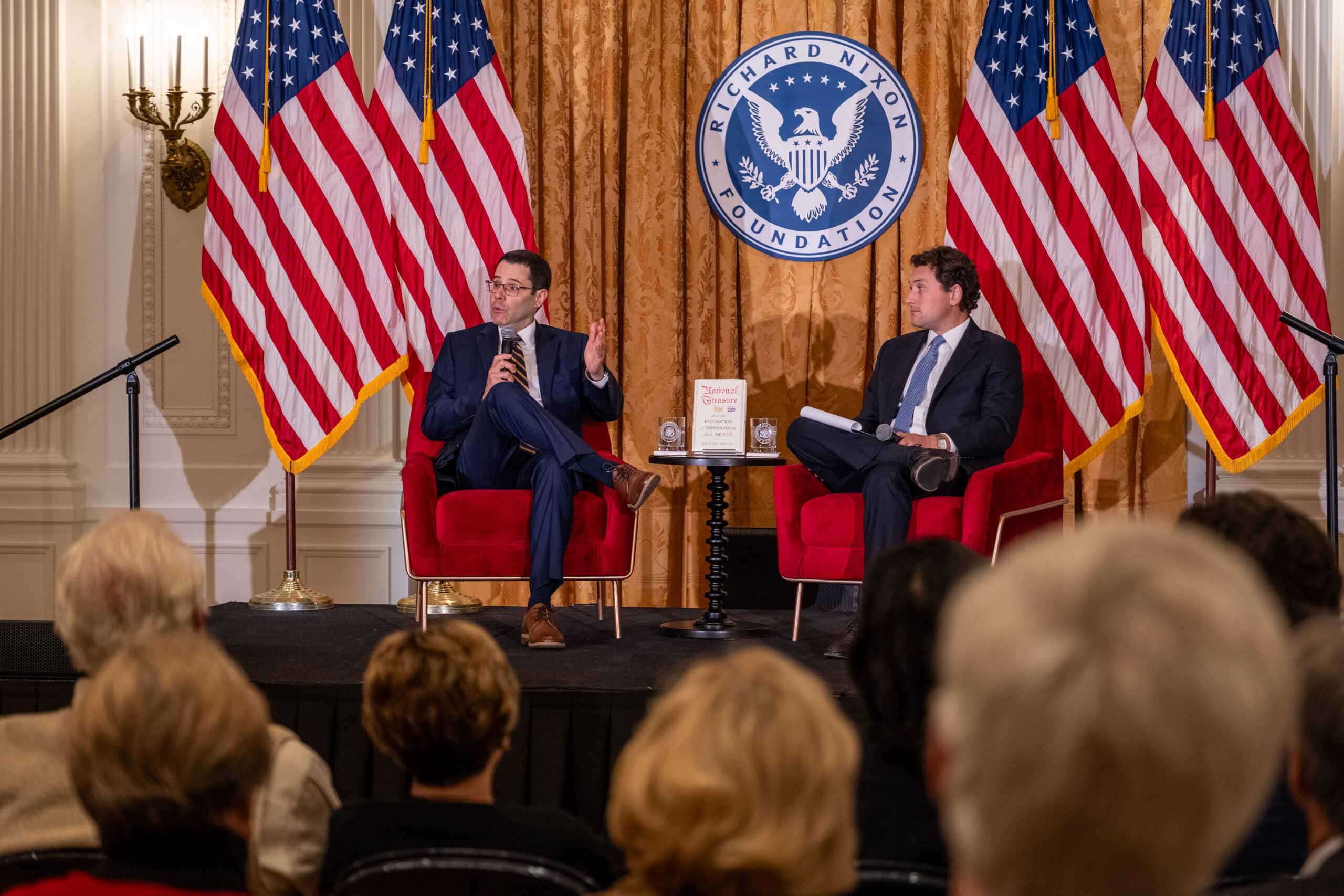
From the artlike cursive script to the huge John Hancock signature at the bottom, the Declaration of Independence is etched in the collective memory of Americans. But surprisingly, that was not always the case. The story of the document’s survival to the way the words have been a symbol throughout the world has all the twists and turns of a page-turning novel. On May 27, award-winning historian Michael Auslin gave a glimpse of how the revered relic and supreme symbol of the American ideal has survived to inspire each generation. The full story is told in his new book, National Treasure: How the Declaration of Independence Made America.
Auslin joined Jim Byron, President and CEO of the Richard Nixon Foundation, who recently returned from fourteen months managing the National Archives in Washington, DC, known for its rotunda with the Declaration of Independence on display. From being forgotten until the War of 1812 to treatment that will make you gasp, pre-modern conservation methods, to multiple moves, the conversation delved into little-known facts about the famous parchment.
When asked what he didn’t know before his research, Auslin responded that he didn’t realize how often Presidents have referred to the Declaration. “To me, it showed how the document remained living, through the great trials we were going through, bringing freedom to much of the world and defeating fascism, but also, living up, ultimately to Jefferson’s promise and Lincoln’s commitment that this would be a land where all are equal.”
Visitors to the current special exhibit at the Nixon Library, America 250: A More Perfect Union, can see a Declaration of Independence on display that was commissioned by John Quincy Adams in 1820. While over 200 copies were made, fewer than three dozen of these copies exist today. Since the original document from 1776 has faded, these copies are what we picture when we think of the Declaration of Independence.
Watch here: