
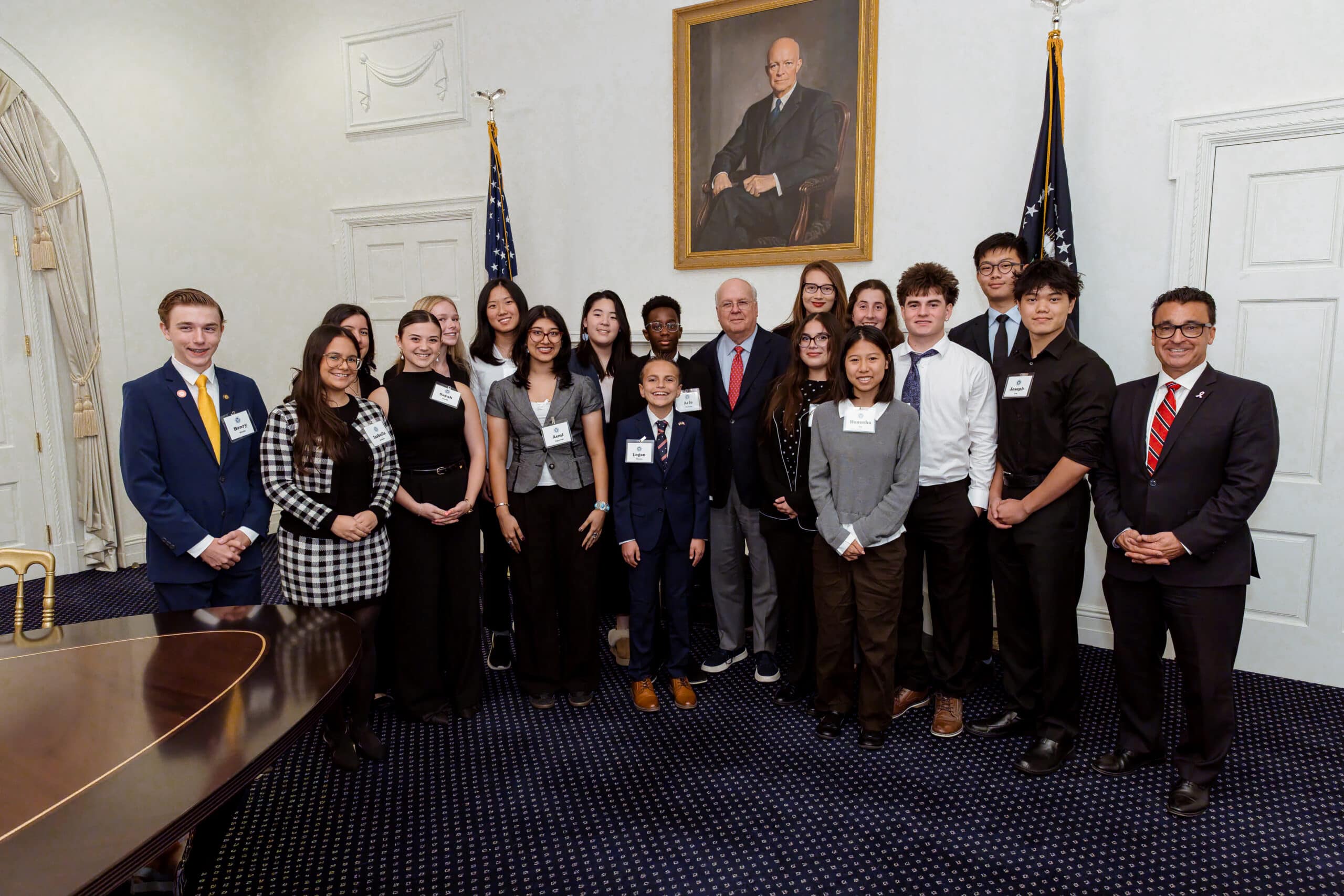
Understanding today’s political climate starts with understanding America’s past, former White House Deputy Chief of Staff Karl Rove told an audience at the Nixon Library on Oct. 27.
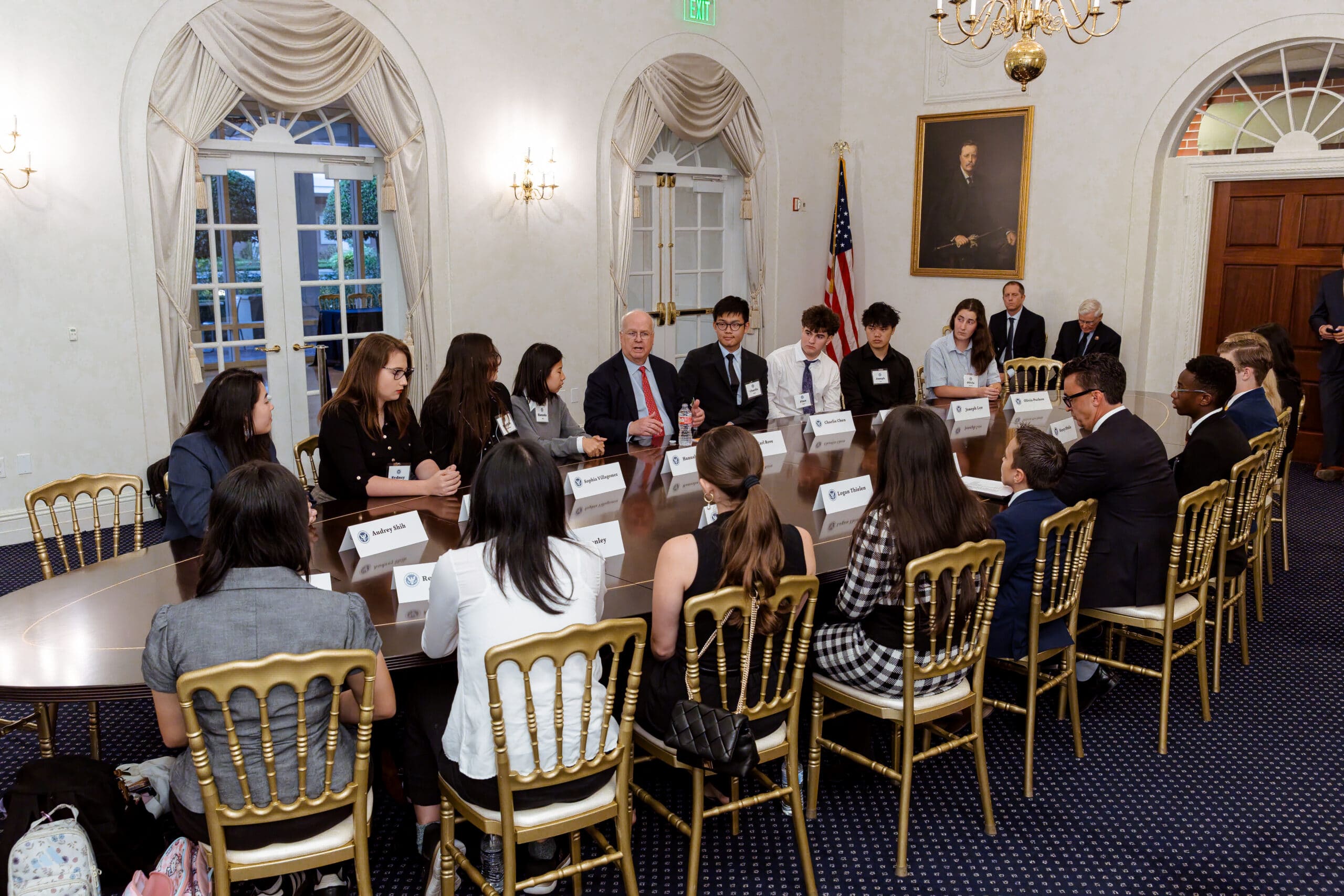
Rove spoke at a National Civics Day program of the Foundation’s Nixon Civic Academy. He met with student participants before the talk and praised their engagement and questions. “My only complaint is we need to have more of it everywhere,” said Rove, a former senior adviser to President George W. Bush who now teaches a course on modern presidential campaigns at the University of Texas at Austin.
Rove opened by asking how many in the room were happy with the state of American politics. No hands went up. “As bad as we think it is today, it’s been worse before,” he said. Rove shared that he is currently writing a book on that subject.
He then walked the audience backward through American history. He described the unrest of the 1960s and early 1970s, when riots spread through cities, campuses shut down and political violence claimed national leaders. He recalled the 1930s, when one in four Americans was out of work and populist voices on the left and right fed division.
Moving to the Gilded Age, Rove said House majorities routinely unseated narrowly elected members of the minority party, which happened about 60 times between 1874 and 1904. He also pointed to the years before the Civil War, when members of Congress came to the floor armed. He ended with the election of 1800. Thomas Jefferson and Aaron Burr tied in the Electoral College, and the House took 36 ballots to choose Jefferson.
“Do not tell me we are too polarized, too divisive, that the American experiment is somehow over,” Rove said. “Don’t tell me that because it’s not true.”
In each of those eras, he said, the country found the leaders it needed. “We find these people because we demand these people,” he said.
Rove said similar work is happening in Washington today. He cited Rep. August Pfluger, R-Texas, who has partnered with Rep. Seth Moulton, D-Mass., on veterans health care. Rove recalled Pfluger telling a supporter that Democrats are “not our enemies. They’re our political rivals.”
“We ought to have confidence in our country,” Rove said. “We ought to have confidence in this great experiment.”
He closed with the story of his great-grandfather, Olaf Julius Rove. Olaf arrived from Norway in 1881 with no prospects, spent his first winter in a cousin’s barn and worked his way through the University of Wisconsin and law school. In 1911, he declined an invitation to become Norway’s first ambassador to the United States because it would have meant giving up his U.S. citizenship, “a prize too dear.” Rove keeps the desk his great-grandfather built that first winter in his living room. He said it reminds him that he is heir to the greatest gift: being born in this country.
In a question-and-answer session, Rove discussed generational gaps in Congress, the role citizens play in demanding better from elected officials, and how social media rewards outrage. “There are fewer legislators and more performance artists,” he said.
Watch here: