
By Ken Khachigian
Richard Nixon’s adversaries perennially commemorate observances of August 9, 1974 as a pinnacle achievement – the vanquishing of the man who sat atop their enemies list. When he returned to his California home 52 years ago, they confidently assured themselves of his final defeat. It mattered not to them that distorted systems of institutional power smashed legal and political boundaries to take down the most popularly elected U.S. President. Even today, it is mere ritual for the established elite in media, academia, and the political Left to feel smug in their ongoing demonizing of the President.
But the angry haters were not aware then, and are not aware now, that the end was only a beginning. Far from shattering the mettle of the grocer’s son from Whittier, the final curtain didn’t come down on August 9th. Instead, it only set the stage for RN’s renaissance and comeback. In his darkest moments just days after his resignation, I sat with him at San Clemente’s former Western White House to resolve overwhelming legal and financial issues. His advice reflected the opposite of defeat and despair: “Ken, we can’t get down. We can’t look back. We must look forward.”
With uncommon human strength and resilience, the 37th President was already on the road to return.
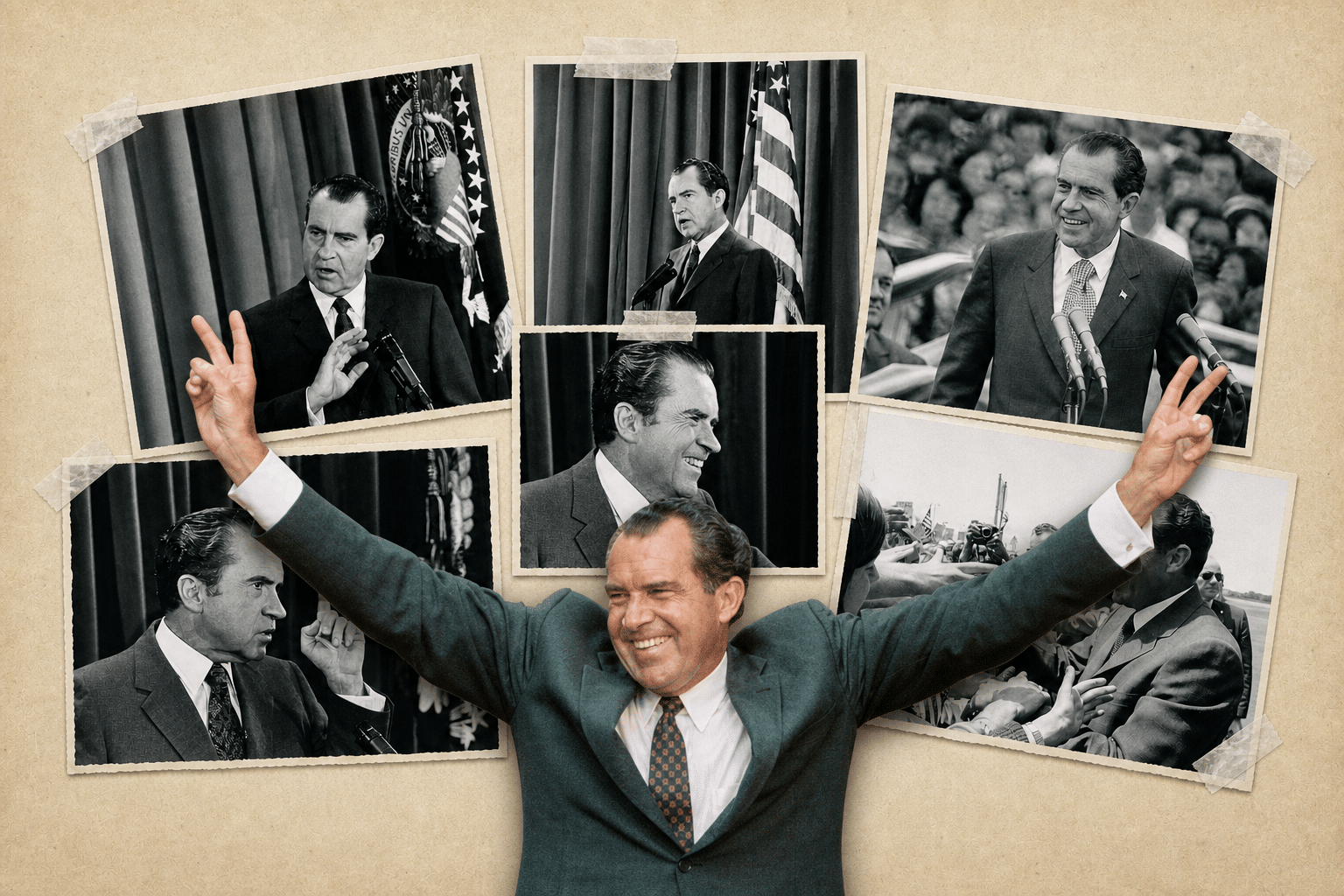
For those, like me, who stood by him to the end to fight unfair impeachment proceedings, today’s tidal wave of “Nixonmaxxing,” and the embrace of a younger generation’s fresh look at the President’s career is heartening. News articles have sprung forward in the Wall Street Journal, Blaze Media, The Free Press, The Spectator, Hollywood Reporter, News Nation, The American Spectator and a half dozen more. Cable hosts and podcasters are struggling to keep up with the phenomenon of viewing Nixon through a lens no longer smudged by the quackery of embittered detractors. There is a massive new interest in “everything Nixon.”
When Vice President J.D. Vance recently visited the Richard Nixon Library, he was unburdened by the musty caricatures of President Nixon. Hence, he rightly observed, “I think that his historical legacy is enjoying a bit of a renaissance. And I think deservedly so.” Vice President Vance also concurred in a view now widely shared by an emerging generation of young people and discerning social media personalities – like those “Nixonmaxxers” cited above: “If Watergate happened tomorrow, it would be like a 12-hour news story. The idea that it would have taken down a presidency is crazy.”
To better understand how today’s younger generation might identify with Richard Nixon in the way I did five decades ago, I refreshed my memories of past August 9th observances by reviewing notes I kept while working with President Nixon on his memoirs. What did we discuss on those “anniversary” dates in his San Clemente office? In 1975, we were occupied by finalizing the David Frost television contract, and “one year later” was not on his mind. In 1976, our conversation revolved around what interested him the most: the intensity of that summer’s presidential race.
But in 1977, our August 9th dialogue zeroed in on the three-year passage of his leaving office, and as I review what the President said that day, I now fully understand why a newer generation would respect Richard Nixon and view him with revised respect, admiration, and integrity.
On that day, with the Pacific Ocean glistening behind a bay window, he leaned back in his brown chair and propped his legs on his ottoman while I handed him an article by a Christian Science Monitor columnist who wrote that Nixon was not dead, had a large constituency, and still had a following among millions of people. The President chuckled at the irony and responded: “After three years after the harassment, the Frost interviews, all the false stories, and all that – we survived, and that’s not bad. That’s what makes them mad; that they can’t finish me off.”
His voice was feisty and energetic as he concluded: “We’ve got some interesting days ahead, Ken. You’re going to enjoy it. We’ve given our opponents a good battle.”
I ended my notes with these final words: “He still wants to fight.”
So, after all he had been through – the resignation, continued efforts by the prosecutors, harassing lawsuits, tax claims, humiliating disbarments, cascades of false stories in the press, and the grinding pressure of the interviews with David Frost, and more – Richard Nixon wanted to do one thing: fight and go forward. It was precisely the same Nixon we knew in his entire career – the one the establishment, the elite, the entrenched and the Left could not embrace. It defined everything that made him great and makes him different and it’s the difference that enamors him among those who now come to appreciate him as those of us who did when we fought with him in the political trenches in the ‘60s and ‘70s – someone who took every punch by the establishment, was knocked down, got up and fought back.
What engages the “Nixonmaxxers?” I think one answer lies in unwrapping the mystery about the person they never knew. For decades President Nixon has been portrayed successfully by those who brought him down – as something like a woolly beast, a nightmare of darkness, some kind of alien in darkened caves. A brooding omnipresence hovering over the heads of good and decent people. Maybe he consumed democratic government and chased his adversaries into their bedrooms. He was a parody in their lives – the perfect creation by those whose resentment of Nixon consumed them for a generation.
Fifty-two years ago, as we begin the final battle, we were already aware that the decks were stacked against the President. The Watergate Special Prosecution staff was led by Jack Kennedy’s opposition research director. Its principal team leaders were led by the top members of Bobby Kennedy’s Justice Department. The Senate Watergate Committee was established by Senator Ted Kennedy. The Washington Post’s Executive Editor was JFK’s longtime personal friend. An antagonistic media and majority Democratic Congress would never allow our message to get through.
Now, historical truths are breaking through the anger, distrust, and shallowness perpetuated by establishment media, political antagonists and academic ladder-climbers. My colleague Geoff Shepard has since discovered even more damning information of lawfare writ large against our President. Mr. Shepard has recovered buried records that the Judge who oversaw the Watergate prosecution was in frequent improper, unethical and perhaps illegal contact with the prosecution staff without the presence of defense counsel, on a minimum of a half dozen occasions. Moreover, the same judge corruptly met with the chief prosecutor to secure a special appeals panel in the D.C. circuit to provide certainty that none of the judge’s questionable rulings would be overturned. These are only a handful of multiple manipulations of legal and political processes, previously hidden; all aimed at taking down Mr. Nixon.
What else do “Nixonmaxxers” see? Perhaps the kinds of things all Americans are looking at. There is no secret cabal of “economic oligarchs” in America as some political figures claim. However, there is a true “oligarchy” against which Nixon inveighed – the centralized media elite, a government controlled by the Left and an intolerance of ideas for the “outsiders” like Nixon who took them on. In New York, in Washington, in the stale bureaus of government – those are the oligarchies that Nixon faced in his career – immovable objects that resented the change he brought to America and to the world.
They are also discovering the positive side of Richard Nixon as presidential giant and political legend. Looking at today’s political and cultural landscape, and with very rare exceptions, Americans search for the intellectual depth and political wisdom that resided in Richard Nixon. In a world strewn with cold blooded killers like Putin and the IRGC, would a Gen Z channel surfer turn first to watch a four-term Congressional talking point reader or hang on every word if Richard Nixon turned up on a Sunday talk or podcast? Anyone touring the Nixon Library captures the breadth of his international stature when they see how he pressed eye-to-eye with Mao tse-Tung, Nikita Khrushchev, Charles De Gaulle, Winston Churchill and Golda Meir.
They also see that he signed Title IX into law which liberated women in sports and the workplace and desegregated schools in the Souths, to which Democrats blinded their eyes. He initiated the end of the military draft, brought in the 18-year-old-vote, cleaned up our air with the EPA and ended cold war isolation from the most dangerous dictatorships in the world: China and the USSR. He saved the State of Israel from extinction and ended the Vietnam War begun by Presidents Kennedy and Johnson.
There is even more they will find out about the former president that will amaze a generation with an open mind. On my book tour, I spoke to college audiences across the country. Among other things, was the important personal side of Mr. Nixon, such as when he consoled his political foe, Hubert Humphrey in his final hours as he lay dying from cancer. They learned that Nixon delivered campaign speeches and commemorative addresses without notes and without teleprompter – rarely ever seen in today’s oratory. In his post-presidency, he never accepted honoraria for delivering addresses. He and Mrs. Nixon saved taxpayers millions of dollars over a decade by paying out of pocket for their own transportation and giving up all Secret Service protection in 1985. He wrote nine best-selling books after leaving office – each of them guideposts of leadership and thought.
There is something else people are learning about our 37th president, much of it disclosed for the first time in my memoir: “Behind Closed Doors – In the Room with Reagan and Nixon.” It’s the opportunity to fully understand that Richard Nixon was the greatest political genius of his era. When I joined Ronald Reagan’s campaign as chief speechwriter in 1980, I became Mr. Nixon’s secret intermediary to the Reagan campaign. In my book, I revealed never-before seen strategy memos Nixon gave me to transmit to Reagan – dealing with overall tactical and strategic counsel to Reagan in the final two weeks of the campaign. Throughout the campaign, Nixon and I exchanged phone conversations in which he would offer advice for Reagan and which I would pass on through Stu Spencer, Reagan’s campaign director.
What my book opens to history is the beginning of RN’s emergence as an occasional advisor and political counsel for Reagan’s presidency. There are additional copies of memos in the appendix of my book for Reagan’s ’84 re-election campaign – written at the request of President Reagan’s staff. These are brilliant reflections by Nixon, putting on display his genius and acumen and should be required reading by all who are interested in understanding the depth, creativity and shrewd perspectives of one who shaped the political landscape in four American decades.
If you have learned something new about President Nixon you didn’t know before, I hope you will share my story with your friends.
Ken Khachigian volunteered for the Nixon presidential campaign in 1968 while attending law school in New York. He served as Deputy Special Assistant to the President from 1970 to 1974 and returned to the former Western White House to assist Mr. Nixon with his memoirs until 1979. Through the remainder of the President’s life, Ken served as political confidant and counsel, oversaw the opening of the Richard Nixon Library, served on the Foundation Board for 25 years and is currently a Board Member Emeritus. www.reaganandnixon.com